New paper on coastal brackish-water invertebrate diversity of Gotland, central Baltic Sea
We are pleased to share that our colleagues from Uppsala University published a paper on coastal brackish-water invertebrate diversity of Gotland, central Baltic Sea.
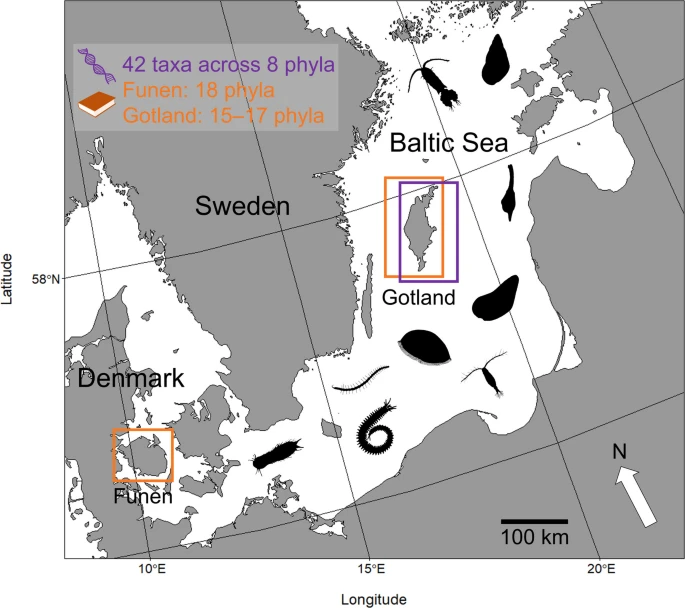
The paper "The unknown known: coastal brackish-water invertebrate diversity of Gotland, central Baltic Sea" is the result of a study aimed to describe the diversity and distribution of invertebrate assemblages (zoobenthos and zooplankton) in the coastal region of Gotland using established eDNA markers, sequencing, and bioinformatic routines.
Abstract
Invertebrates are key components of coastal ecosystems, yet their diversity and distribution in the Baltic Sea often remain poorly resolved due to methodological constraints. This study employed environmental DNA (eDNA) metabarcoding of the 18S rRNA gene to characterise invertebrate assemblages from nine water samples (depths < 0.5 m) collected at three coastal sites around Gotland, Sweden, in summer 2021. Sequencing yielded 506,424 high-quality reads representing 42 invertebrate taxa across eight phyla. Arthropoda dominated both taxon richness and sequence abundance, with the copepod Acartia (Acanthacartia) tonsa detected in nearly all samples. Alpha diversity metrics indicated low to moderate richness (8–18 taxa per sample), with some spatial differentiation among sites. Principal coordinate analysis based on Jaccard dissimilarities explained 57.5% of the variability; PERMANOVA revealed a significant difference in assemblage composition among sites. Most identified taxa were holoplanktonic (57.5%). Benthic (22.5%) and meroplanktonic (20.0%) species were also detected, demonstrating the ability of sub-surface eDNA sampling to capture both pelagic and benthic communities in shallow (< 5 m) waters. Comparison of phylum-level diversity between Gotland and the more saline Danish island of Funen (based on literature and open-access repository information) revealed a lower richness around Gotland (15 vs. 18 phyla), likely reflecting both environmental gradients and research intensity. This study provides the first eDNA-based inventory of marine Gotlandic invertebrates and highlights the potential of molecular tools for integrating invertebrate diversity into biodiversity assessments and the monitoring of essential ocean variables (EOVs) in the Baltic Sea.


