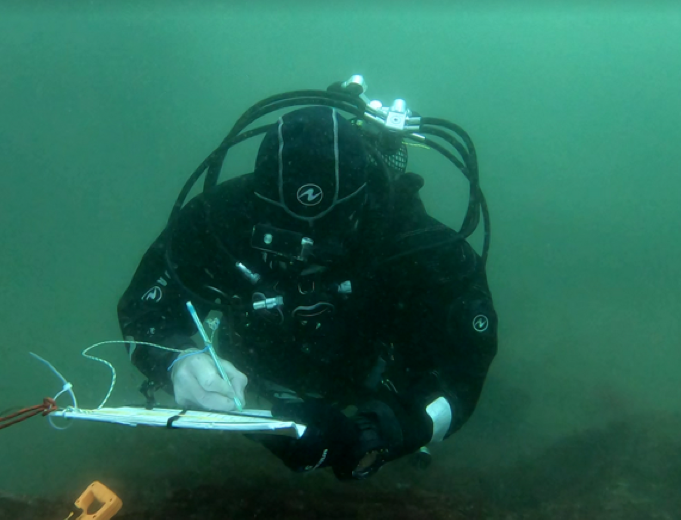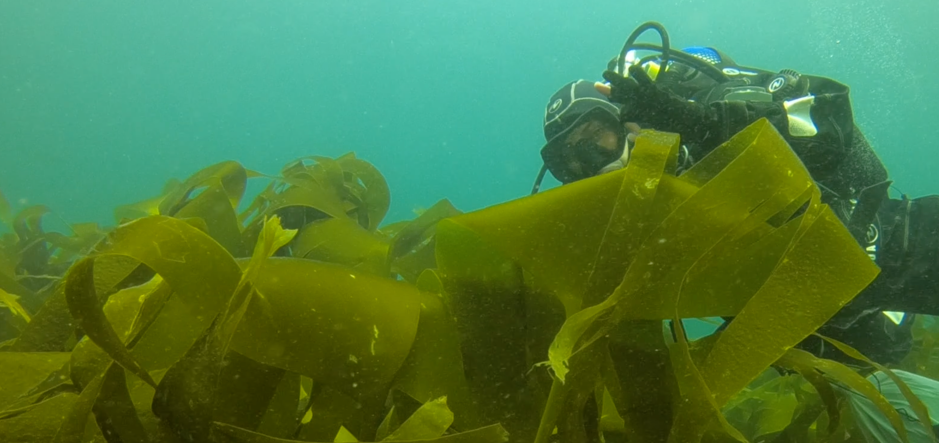
Scientific diver in a kelp forest.
Photo by João Franco.
Scientific diver in a kelp forest.
Photo by João Franco.
The CIIMAR team carried out field campaigns in 2024 and 2025 to test the feasibility of using environmental DNA (eDNA) to assess macroalgal canopy composition. These surveys were conducted along the North and Central coast of Portugal within the Atlantic Living Lab.
Because genetic reference information is still very scarce for many of our macroalgae target species, this work is exploratory and focuses on understanding whether clear and reliable genetic signals can be detected from water samples. We are therefore testing and refining the method to evaluate its potential for monitoring macroalgal communities in our region.
In addition to the field campaigns, tank trials were performed under controlled conditions to better understand how macroalgae eDNA is detected. Together, these approaches help assess whether eDNA can become a useful complementary tool for future monitoring of macroalgal canopies.
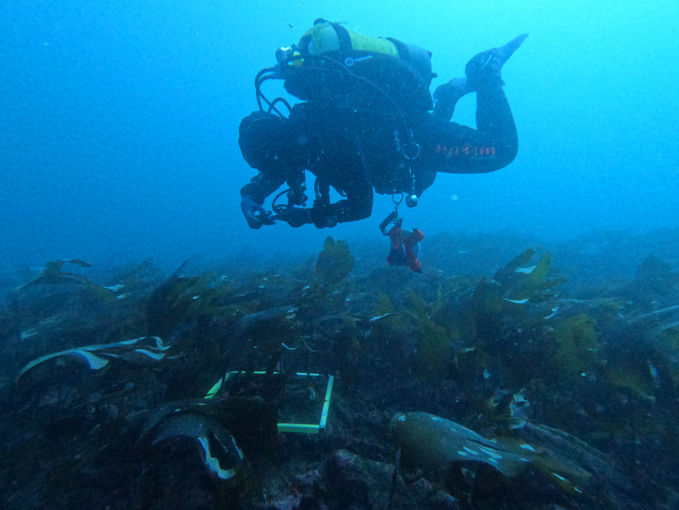
Quadrat sampling in a Laminaria hyperborea forest in the North of Portugal. Photo by Hugo Sainz-Meyer.
Diver performing visual sampling of canopy composition. Photo by Bianca Reis.
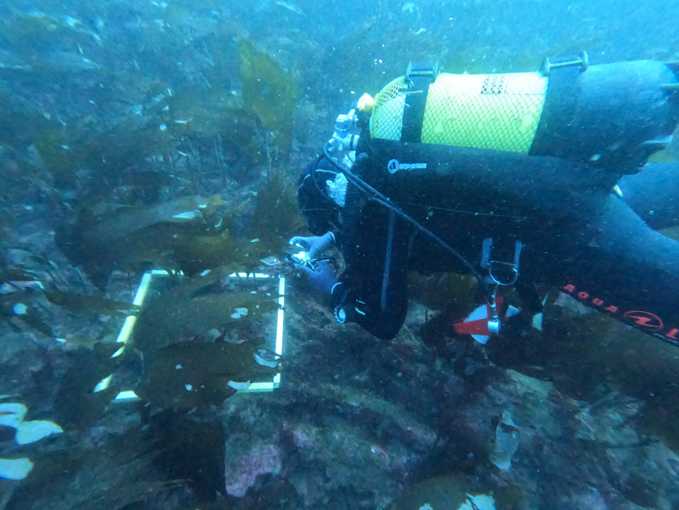
Photo and visual sampling of canopy composition. Photo by Hugo Sainz-Meyer.
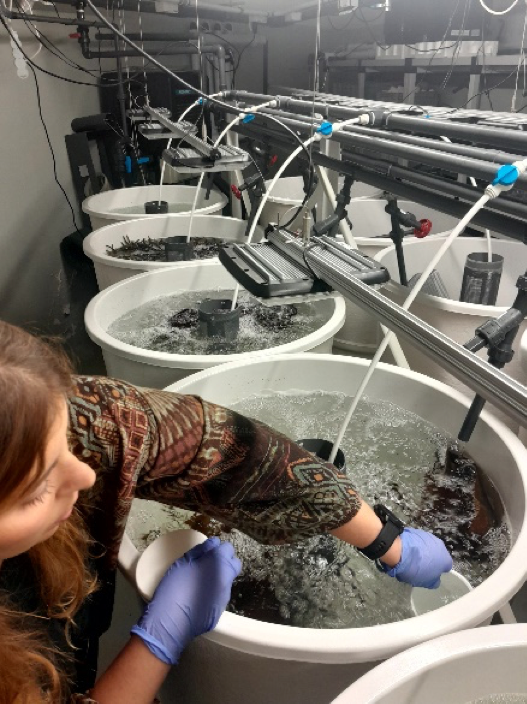
Collection of water samples from tanks for eDNA calibration and method optimisation. Photo by Débora Borges.
The CIIMAR team carried out mesocosm experiments to study how kelp species respond to increasing temperatures under climate change conditions. We worked with recruits of three species, Saccharina latissima, Laminaria ochroleuca, and Laminaria hyperborea, exposing them to different combinations of temperature and nutrient levels.
From these experiments, we calculated thermal performance curves and identified the thermal optimum and maximum for each species. These values show the temperature at which each kelp grows best and the upper temperature limit it can tolerate.
This information is essential for modelling and predicting how kelp forests may change in the future. It also provides practical guidance for conservation and restoration actions, helping to select suitable sites, define realistic restoration targets, and anticipate which species are more vulnerable or resilient to ocean warming.
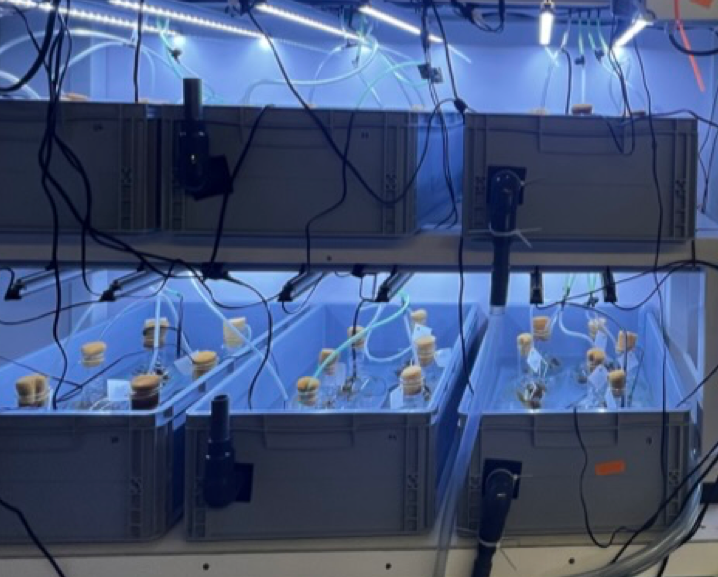
Mesocosm system simulating climate change conditions. Photo by Bianca Reis
Unoccupied Aerial Vehicles (UAVs) equipped with RGB and multispectral sensors, complemented by in situ work, are used to map the aerial extent of macroalgae in northern Portugal. Such information will be integrated with satellite multispectral data (Sentinel-2) with the application of machine learning algorithms for expansion of the covered mapping area. The combination of high-resolution Sentinel-2 imagery with UAV observations enables the transfer of fine-scale spatial and spectral information to satellite data, improving the discrimination of macroalgal features at broader scales. This multi-platform approach supports robust upscaling of local UAV-derived classifications to regional coastal monitoring frameworks.
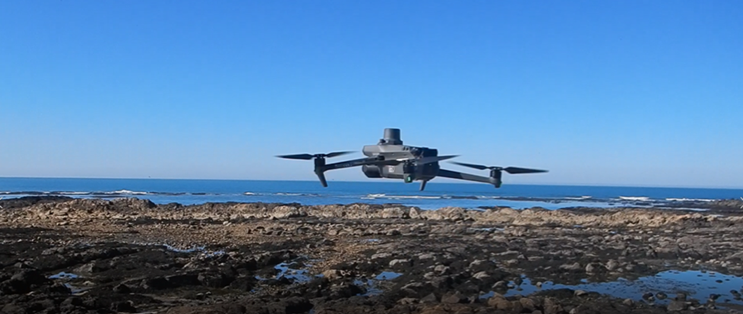
UAV (Mavic3M) flying over Praia Norte (Viana do Castelo, Portugal).
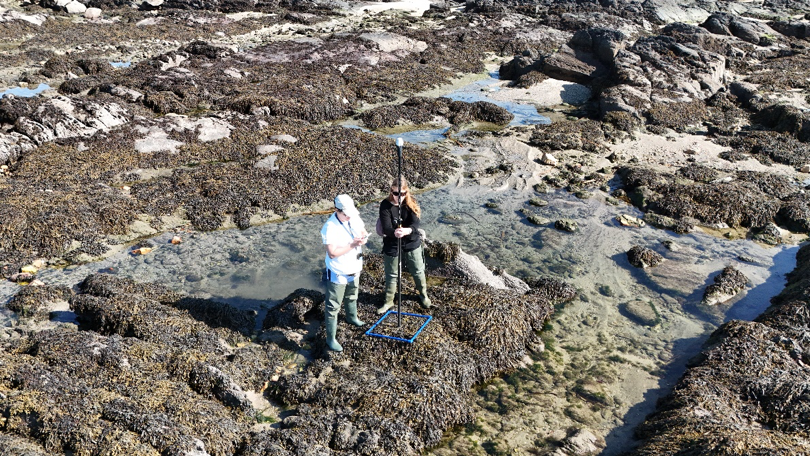
Collecting GPS coordinates of macroalgae at Praia Norte (Viana do Castelo, Portugal).
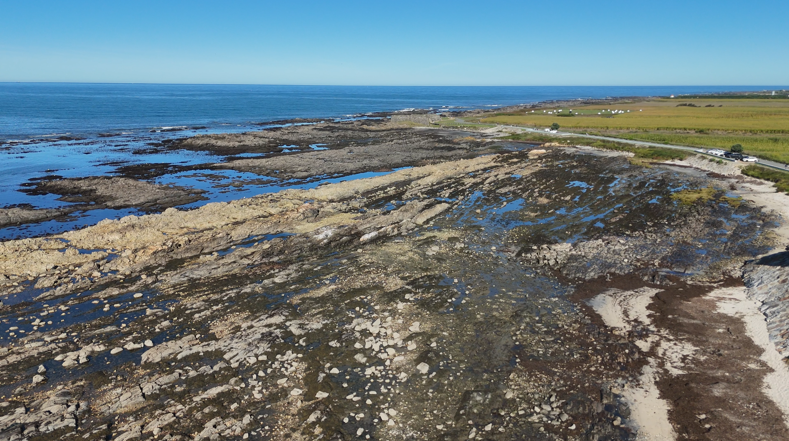
Views from the UAV of Praia Norte (Viana do Castelo, Portugal).
The next phase of the Atlantic Living Lab will focus on consolidating and integrating the work developed so far.
Together, these efforts will keep contributing towards building a more integrated and flexible observation framework, capable of supporting long-term monitoring, climate change impact assessments, and ecosystem-based management.