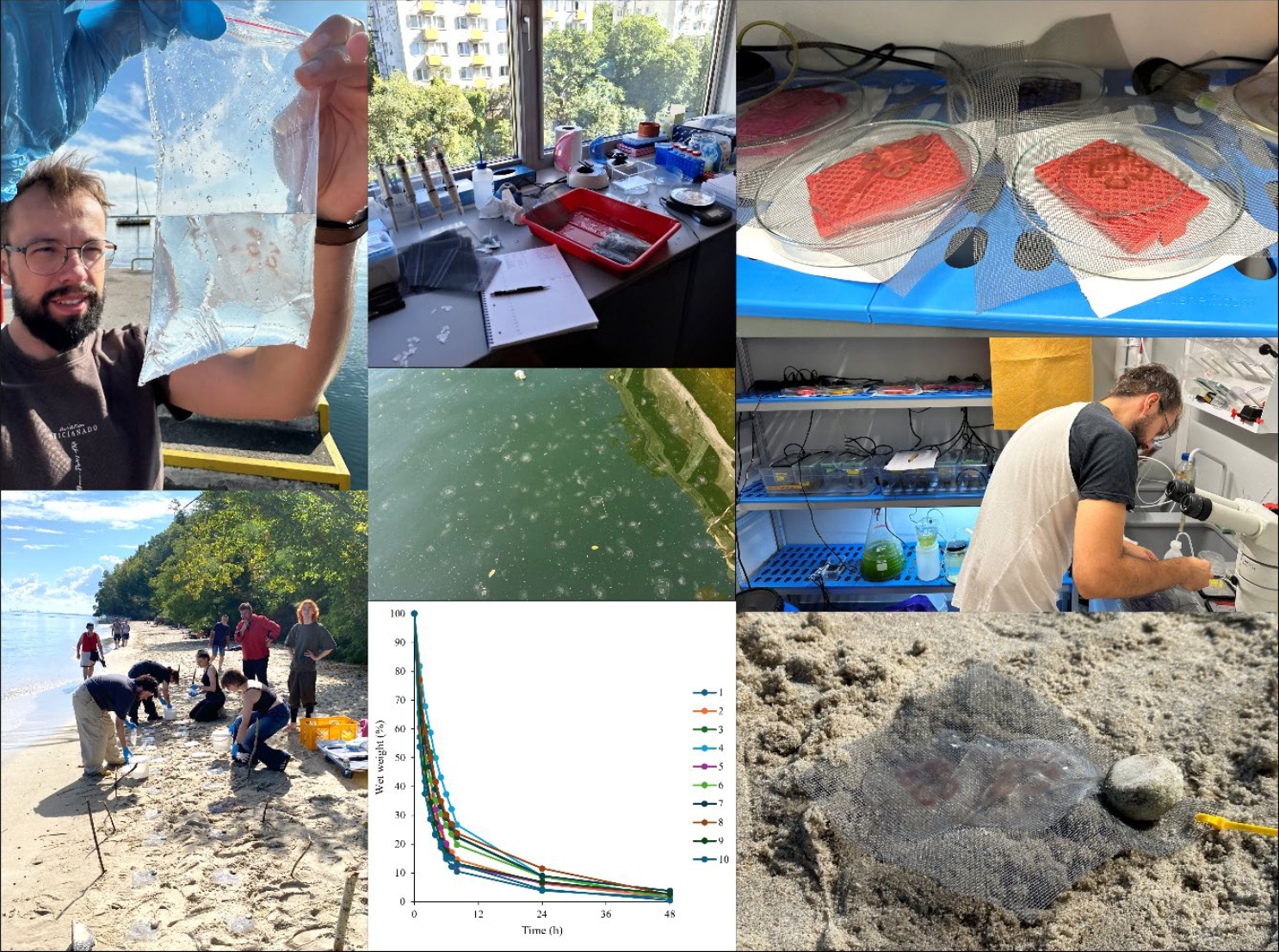
Picture credit: Florian Lüskow and Maciej Mańko
We are pleased to share that the BioEcoOcean project co-funded Dr Florian Lüskow’s fieldwork on the Polish Baltic coast to investigate what happens to stranded moon jellyfish (Aurelia aurita) and how their decomposition may affect life in the sand. With support from a The Baltic University Programme Mobility Grant, Florian travelled from Uppsala University to work with Dr Maciej Mańko and students at the University of Gdansk in August and September 2026.
Laboratory experiments showed just how quickly the jellyfish dried out. After 48 hours, only about 2% of their original weight remained. On a beach near Gdynia, the team tracked the release of water and mucus and collected sand samples hourly for eight hours. Students at the University of Gdańsk are now analysing the samples to see how tiny animals living between sand grains, including nematodes and flatworms, are distributed beneath stranded jellyfish and whether they are attracted or repelled by it. Their work will help clarify how jellyfish strandings transfer organic matter from the Baltic Sea to its shores.
Read Florian’s full fieldwork report (PDF)


